Northern Vietnam: Travel Tips and What to See
Northern Vietnam: Travel Tips and What to See
9/13/20257 min read

Why Visit Northern Vietnam?
Northern Vietnam offers an immense variety of landscapes, from the Gulf of Tonkin with its towering limestone islands to the Red River and Black River traversing fertile countryside. Low hills lead up to plateaus and mountain ranges, making this region an ideal destination for trekking and excursions.
You will also find historic centers like the capital Hanoi and the imperial citadel of Ninh Binh, where Chinese cultural influences are evident in the traditional architecture. Northern Vietnam provides a perfect blend of natural adventure and deep cultural exploration.
What to See in Northern Vietnam
Hanoi
A Northern Vietnam tour cannot disregard Hanoi: the political, economic, and cultural heart of the country. The oldest part of the city consists of a maze of 36 streets, home to a varied panorama of local humanity. Each street was once dedicated to a specific trade, a vocation still discernible today. You will find countless workshops, vendors, and an even greater quantity of merchandise on display.
Evenings in Hanoi's Traditional Alleys
Moving away from the crowds, tranquility and rest can be found in the city's numerous bodies of water. The West Lake hosts the Tran Quoc Pagoda, one of Hanoi's most well-known and important, on a thin strip of land. Located in the Old City, Hoan Kiem Lake (Lake of the Restored Sword) evokes legendary stories referencing the city's liberation from foreign invaders.
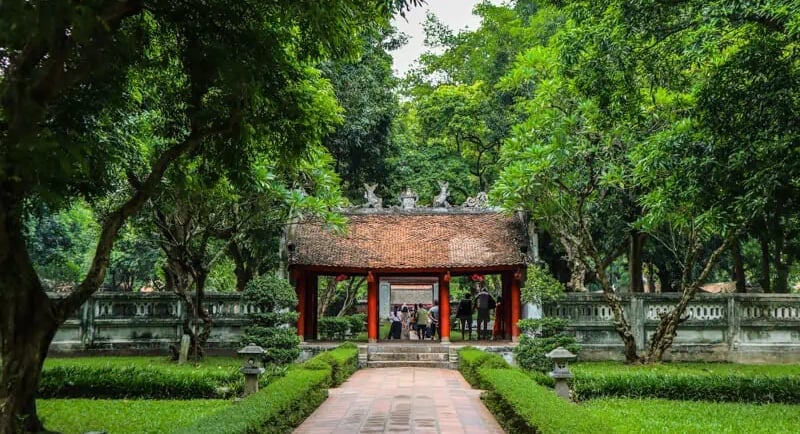
Not far from the ancient commercial district, the Temple of Literature has been the cultural heart of Hanoi since its founding in the 11th century. It is the first and oldest university in Vietnam and attracts intellectuals and thinkers from every corner of the country. It is a national symbol, so much so that it is featured on the back of the 100,000 Dong banknote. Our city tour continues along a cultural route towards the Ethnology Museum to discover the tribal ethnic groups of Northern Vietnam. The main building houses a vast assortment of photographs, artifacts, and information boards on the traditions of the country's ethnic minorities, while a second pavilion holds an extensive collection of artifacts from all over Southeast Asia.
Cat Ba Island (Ha Long Bay)
The largest island in Ha Long Bay stretches over 300 square kilometers into the Gulf of Tonkin. In 2004, it was declared a Biosphere Reserve due to its incredible variety of wildlife and its extraordinary natural wonders. There are many beaches on Cat Ba Island, easily reachable by bicycle or the omnipresent scooters. The beaches on the hundreds of islets in the nearby Lan Ha Bay, dotted with karst towers plunging into the sea, are less trodden. This landscape, carved by water and wind, features amazing natural nooks like the Hospital Cave, used as a refuge during the American War, and the Trung Trang Cave with its astonishing stalactites.
The central territory of the island, which corresponds to the park area, is a natural feast of karst mountains covered by tropical vegetation. The area is sparsely populated, with the sole exception of the isolated fishing village of Viet Hai in the eastern part. This destination is not easy to reach, but the visit amply rewards the effort, as it feels like stepping into a distant time when dozens of aquatic communities inhabited Ha Long Bay. Cat Ba Island is undoubtedly one of the most visited, but it is also easy to get off the beaten track to find isolated spots and panoramic views that make it one of the must-see destinations in Northern Vietnam.
Bai Tu Long Bay
Among the tours in Northern Vietnam, the one to Bai Tu Long Bay offers a less crowded but equally suggestive itinerary compared to the better-known Ha Long Bay. Located northeast of the latter, it offers a nearly identical landscape where the omnipresent limestone towers alternate with a constellation of islands and islets. The Vung Vieng fishing village, reachable by kayak, offers a glimpse of authentic local life.
The Bai Tu Long National Park hosts an extraordinary variety of flora and fauna, while Cap La Island, with its evergreen rainforest, is a destination for hiking and snorkeling enthusiasts.
Huong Pagoda
Not only a remarkable architectural and religious complex but also a meeting place for the thousands of pilgrims who travel to the Huong Pagoda to celebrate the Bodhisattva Kwan Yin, who achieved enlightenment here, during the three months of festivities. The temples are exclusively accessible aboard boats awaiting at the small pier of the nearby town of My Duc. An hour's journey along the river allows visitors to admire the dramatic scenery of the surrounding mountains, on whose slopes the temple complex is perched.
The first stop is the Thien Tru Pagoda (Heavenly Kitchen), followed by the Giai Oan Pagoda, and finally, after a long path winding through the jungle, the pilgrimage reaches its culmination in the Huong Tich Cave. Inside, the eponymous pagoda is a natural temple adorned with stalactites and stalagmites, where the scent of incense intoxicates the mind and the devotees' litanies warm the soul.
Ban Gioc Waterfalls (Vietnam – China Border)
At the northeastern extremity of Vietnam, the Song Quay Son River marks the border with the People's Republic of China. This rugged territory is cut by deep valleys and steep mountains. It certainly requires a good dose of patience to reach the Ban Gioc Waterfalls, but the time and effort will undoubtedly be rewarded. This spot should rightfully be in the top ten of what to see in Northern Vietnam, yet this natural wonder remains a little-known gem; all the better for those reading this article!
More than three hundred meters wide at its maximum point and with a drop of thirty meters, the Ban Gioc waterfall system develops into multiple tiers, which, depending on the season and thus the water flow, can expand into hundreds of smaller streams. In the surrounding landscape, narrow valleys are covered with rice fields, while limestone peaks, shrouded in the steam generated by the current, rise all around. A natural marvel that is worth the eight-hour journey from the capital, Hanoi.
Dong Van Karst Global Geopark (Ha Giang Province)
When discussing things to do in Northern Vietnam, it is impossible to overlook the Dong Van Karst Park, in the northernmost province of Ha Giang. The area, covering over 2,000 square kilometers, is an open-air geological museum.
Innumerable fossilized organisms—fish, bivalves, brachiopods, and trilobites—dating back to the Cambrian period (500 million years ago) have been discovered in the rock formations. Orographically, the territory is mountainous, with an altitude ranging between 1,400 and 1,600 meters. Narrow, deep valleys wedge between the limestone mountains covered by dense tropical vegetation, creating impressive vistas. The natural environment is rich in flora and fauna, including the snub-nosed monkey, rediscovered here in the early nineties.
Trang An Landscape Complex (Ninh Binh)
Recognized since 2004 as a cultural and natural World Heritage Site, the Trang An Landscape Complex is often referred to as the "Ha Long Bay on land." Its karst formations—limestone towers soaring from the surrounding plain—are indeed very similar to those of the bay. The only thing missing here is the sea, but travelers do not seem to worry too much, busy admiring the surrounding scenery in an alternation of amazement and wonder. A tour of the complex can be done both with a suggestive boat trip or via the various paths in the park: on foot or by bicycle.
Among the places to visit in this remote province of Northern Vietnam, we suggest the idyllic Sung La valley, with its wooden houses at the center of a narrow plain covered with rice fields. An excursion along the Ma Pi Leng Pass allows visitors to appreciate the ruggedness of the surrounding territory, with the gaze plunging down to the waters of the Nho Que River. The town of Dong Van and its historic center, with stone houses boasting at least a few hundred years, constitute valuable examples of Chinese-style architecture.
The Hoa Lu Imperial Citadel is one of the most notable architectural complexes in Northern Vietnam in terms of size and style. The ancient capital of the country between the 9th and 10th centuries (A.D.) is traversed by the waters of the Hoang Long River, which continues through a complex system of canals to the sea. Many of the original buildings have been destroyed, but rest assured that a visit to the site will allow you to appreciate the charm of one of the most beautiful places in Northern Vietnam.
Mai Chau (Hoa Binh Province)
The Mai Chau district is located about a hundred kilometers southwest of Hanoi. The low hills in the eastern part of the territory open into wide flat areas dedicated to the millennial cultivation of rice. To the east, the district borders a bend of the Black River which, near the village of Suoi Rut, wedges deep, forming a modest fjord. In these parts, water shapes the friable calcareous earth with extreme ease. All you need is patience—a quality that seems to characterize the local atmospheres, immersed in a silence capable of shocking if you arrive here from crowded Hanoi. But what drives people to Mai Chau is precisely the dreamy gaze upon less trodden landscapes, country houses, and locals ready to welcome you.
While this might sound like a saccharine postcard, it is the reality of a territory where everything still seems suspended, waiting for a journey on slow paths that we hope will remain so.
Ba Be National Park (Bac Kan Province)
A small park in the heart of Northern Vietnam that takes its name from the lake of the same name: the largest natural freshwater body in the entire country. This important water resource guarantees the growth of a lush forest of evergreen plants that protect varied fauna, consisting of Himalayan black bears, monkeys, otters, bats, and numerous other vulnerable mammals. Along the southeastern shore of the lake, the small village of Pac Ngoi is the ideal destination for those intending to visit the park. Just 400 inhabitants, houses on stilts, and an architectural style influenced by China. The location is certainly suitable for those looking for naturalistic routes far from the beaten track—an eco-trip into rural Vietnam and its ancient traditions.
Sa Pa
The town of Sa Pa constitutes the ideal starting point for those intending to participate in a trekking tour in Northern Vietnam. Here, human activities have integrated with the natural environment through a process lasting hundreds of years, taking the visitor back to the ancient traditions of Vietnamese culture. Situated at an altitude of 1,650 meters above sea level, Sa Pa still preserves colonial-era evidence, such as its small church in the center of the town and some notable French-style buildings.
The most authentic heart of Sa Pa is represented by its market, set up along Cau May street. A riot of colorful clothing worn by the inhabitants of the tribal villages living in the surrounding mountains who come to town to exchange and sell their products in a tradition that still preserves bartering as the preferred method of commercial exchange.
Contact Us
© 2025. All rights reserved.
Claim Your Guide Now!
Free
Your Complete 7-Day Vietnam Itinerary