
Halong Bay: Myths, Legends, and Breathtaking Landscapes
Halong Bay: Myths, Legends, and Breathtaking Landscapes
9/18/20253 min read

The House of Dragons is Right Here
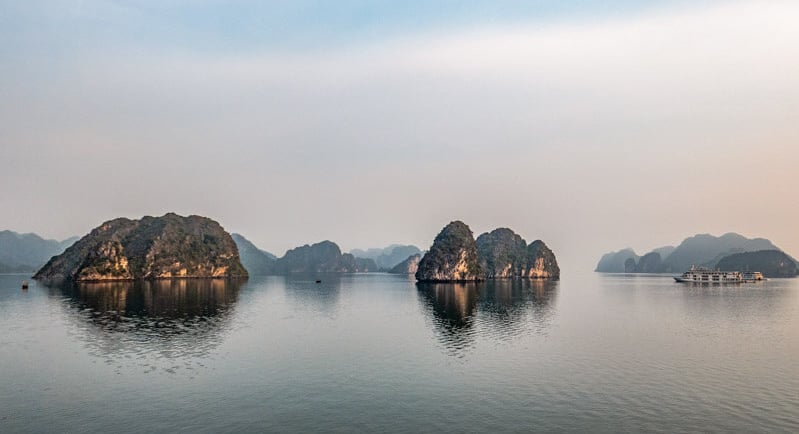
It was the dragons that protected the Vietnamese from invaders, spewing jewels from their mouths that, upon contact with water, created islands and stone towers, preventing enemy ships from advancing further. From the sea, they brought forth rocks that shattered hulls, and when nothing remained of the defeated but wood and bodies, the dragons found shelter in the islands of Ha Long Bay.
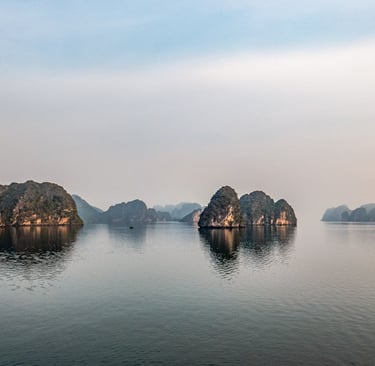
Ha Long Bay at sunset
The legend remains alive in the Vietnamese imagination as a founding narrative of the emerging nation-state against Chinese invaders from the north. A mythology that during a cruise in Ha Long Bay is easy to recall, facing its landscape so varied and evocative that it generates wonder wherever you look. Whether it's a cruise or excursions to the caves of Sung Sot, Tam Cung, or Trinh Nu, Ha Long Bay is an unmissable destination.
Ha Long Bay: Map and Must-See Places
In Ha Long Bay, the number of islands present in this geographic area pushes the imagination beyond the limits of time available for a single trip. For this reason, I've highlighted the destinations and places that in my opinion are worth seeing during a cruise or bay excursion.
Cat Ba Island
The island is easily accessible from the nearby city of Haiphong and is among the preferred destinations for day cruises. Cat Ba National Park is a biosphere reserve with an ecosystem that includes wetlands, mangrove forests, and coral reefs. Excursions can be conducted without too much difficulty: signage is present and trails are well marked—just choose the one most suitable based on your available time and physical fitness.
Cat Ba Island – Ha Long Bay
The park entrance ticket allows you to visit Trung Trang Cave, with its impressive stalactites, and from here continue south to the fishing village of Viet Hai nestled in a narrow valley between limestone peaks. Alternatively, you can reach it by sea, disembarking at Viet Hai pier.
Dau Go Island
Located on the island of the same name, the colonial name "Grotte des merveilles" (Cave of Wonders) is joined by the more prosaic "wooden stakes cave" (Dau Go), a memory of the use made of it during the Mongol advance of Genghis Khan. Among the largest in Ha Long Bay, you need to climb a staircase of ninety steps to reach its entrance. Like other caves in the area, Dau Go Cave is in an elevated position, formed following the water's retreat that occurred thousands of years ago.
A couple of kilometers north along the coast, we encounter a second natural wonder, rediscovered in 1993 by a group of fishermen surprised in the bay by a storm: Thien Cung Cave.
Titov Island
The island takes its name from the Russian cosmonaut who visited it in the company of Ho Chi Minh in 1962. It's one of the smallest in the bay, extremely popular among snorkeling and climbing enthusiasts. The former appreciate the clear water and its seabed, while the latter can venture along its rocky walls to the hilltop, which offers an open view of the entire bay. The less adventurous can enjoy the beach where food and cold drinks are served.
Bo Hon Island
On Bo Hon Island, you'll find some of the bay's most famous caves, evocative settings that are rarely seen in other parts of Southeast Asia. Luon Cave is accessed by sea through a gigantic limestone arch, leading to its internal lake surrounded by rock pinnacles.
In the central part of the island is Trinh Nu Cave, known by locals for the legendary love story between two young people, prevented by a powerful local figure.
About three kilometers away is Sung Sot Cave, divided into two enormous chambers connected by a narrow passage. You access the cave by climbing about fifty stone steps until you reach a panoramic terrace overlooking the bay.
Dau Be Island and Ba Ham Lakes
Following less beaten paths, there's the tranquil Dau Be Island, where you'll find a tunnel system connecting its three lakes, accessible exclusively by canoe or traditional Vietnamese sampan boats. The Ba Ham lakes are internal bodies of water accessed through rock arches. It's highly recommended to rely on local guides and not venture individually into the lakes, at the risk of becoming trapped when the tide rises.
Contact Us
© 2025. All rights reserved.
Claim Your Guide Now!
Free
Your Complete 7-Day Vietnam Itinerary